Description
STARTING AUGUST 2026
Ayurvedic Herbology. Learn about Ayurvedic herbs and prescribing.
With a range of content (including live tutorial groups, PDFs, videos, a community forum, herb sampling, quizzes and case studies) the course offers both theoretical and practical learning to give full confidence to prescribing key Ayurvedic medicinal herbs. All content is direct from the classical Ayurvedic texts combined with modern interpretation, supported by research.
This course runs every 18 months and takes 6 months.
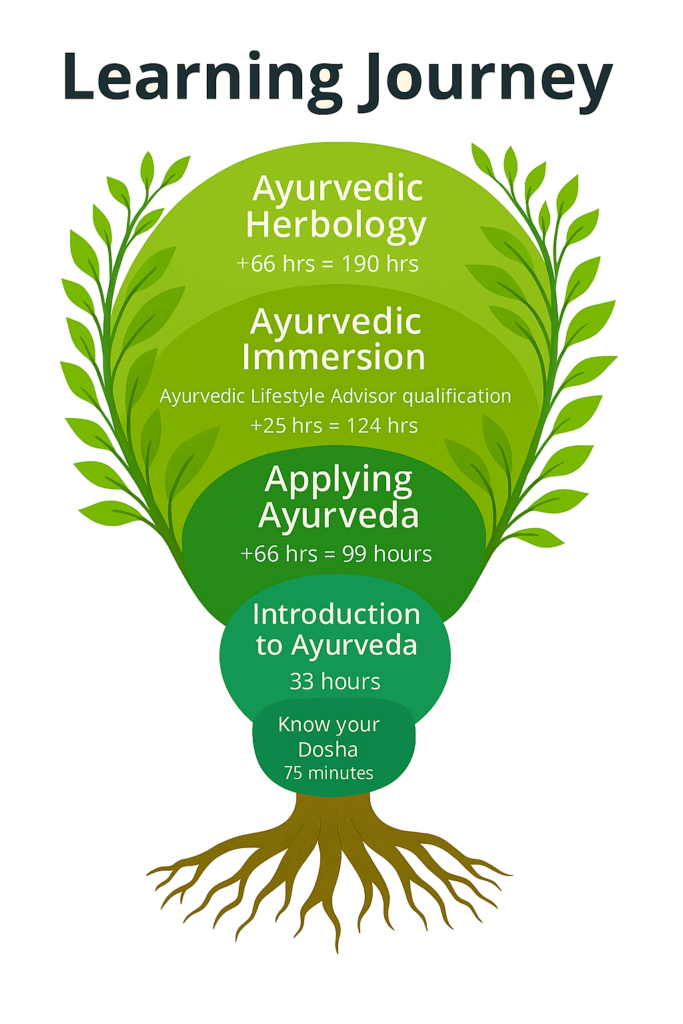
You will need to have completed Applying Ayurveda (or equivalent external course) to join this course. To be able to prescribe herbs and be covered by insurance, you will need to complete Ayurveda Immersion (or equivalent).
This Ayurvedic Herbology course will enable you to:
- Describe the foundational principles of Ayurvedic herbology, including rasa (taste), virya (potency), vipaka (post-digestive effect), karma (action), prabhava (unique effect), and anupana (vehicle).
- Identify the properties, actions, and therapeutic uses of 19 key Ayurvedic herbs, including their relevance to dosha imbalances and common ailments.
- Evaluate safety considerations in herbal prescribing, including herb-drug interactions, contraindications, side effects, and sustainability.
- Deepen assessment of a client’s constitution, current state of health, and presenting symptoms using Ayurvedic diagnostic tools and consultation methods
- Design appropriate herbal prescriptions tailored to individual client needs, using single herbs or synergistic formulations.
- Explain the rationale behind herbal recommendations to clients, including expected outcomes, dosage, and method of administration.
- Demonstrate an understanding of ethical boundaries and scope of practice in herbal prescribing, including when to refer or signpost to other professionals.
- Apply Ayurvedic treatment principles (langhana, brmhana, deepana, pachana) to guide herbal choices and support healing.
- Reflect critically on case studies and client feedback to refine prescribing decisions and deepen clinical insight.
Once you have completed the Ayurvedic Herbology course, you will receive a certificate of completion, certifying your 66 hours of structured study. This will enable those holding an existing professional Ayurvedic qualification to prescribe these cornerstone herbs to clients with insurance cover.
What you’ll learn:
Ayurvedic treatment principles (revision)
- Qualities, elements and dosha (incl subtypes)
- Digestion and Metabolism
- Tissues (dhatu)
- Channels (srota)
- Wastes (mala)
- Treatment concepts – langhana (with specific reference to deepana, pachana), brmhana
Herbal energetics
- Substance (dravya) (modern classifications, habitat, general growth form, duration of life, ayurvedic classification of plants).
- Properties (guna)
- Taste (rasa)
- Post-digestive taste (vipaka)
- Potency (virya)
- Specific, unexplainable action (prabhava)
- Actions (karma)
- Herbal forms (kalpana)
- Accompaniment (anupana)
- Dosage (matra)
- Time of administration (bhaishajya kala)
- Route of administration (bhaishajya marga)
- Safety
Herbs I & II
- Profiles of 19 key Ayurvedic herbs/formulations: aloe vera, amalaki, andrographis, ashvagandha, brahmi, fennel, ginger, guduchi, guggulu, haritaki, licorice, neem, pippali, shallaki (frankincense), shatavari, trikatu, triphala, tulsi, turmeric.
- Case studies
Ayurvedic Prescribing
- Making formulations – the synergy of herbs
- Prescription pads by channels/tissues
- Treatment of common ailments
- Case studies – disease and dosha focus
Case studies
- Applying all learned information to live cases with full dietary, lifestyle and herbal prescription.
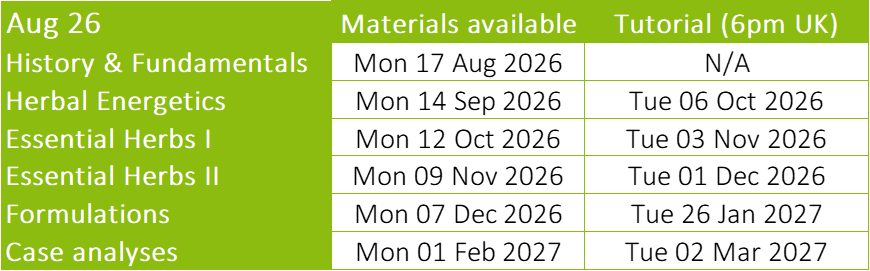
Dates for upcoming course:
To receive a certificate of completion, you
must attend at least four of the five live tutorial sessions during the six-month course.
Tutorials last 75 minutes. The first module does not have a tutorial.
All of The Ayurveda Academy courses include:
- A comprehensive syllabus covering everything you need to know to start applying Ayurveda’s wisdom to your daily life
- Engaging monthly content with assessments and case studies
- Knowledge direct from the classical Ayurvedic texts combined with modern interpretation, supported by research where possible
- Small live interactive monthly tutorials focussed Q&A and case studies
- Access to a collaborative close-knit learning community to share ideas, practical tips and learning.
- Health diaries to enable you to record your experiences – not all advice will work for everyone so what is really best for you?
- Downloadable course materials and tutorial recordings
Course Structure
Cancellations
Please note that, cancellations can not be refunded within 28 days of the course start date. If you cancel more than 28 days of the course start day, we will refund your money minus a £10 admin fee.